
Pressure vessels operate under sustained internal pressure, thermal cycling, and mechanical stress. Any weld defect, material flaw, or loss of thickness can escalate into leaks, unplanned shutdowns, or catastrophic failure. Nondestructive Testing (NDT) is a critical requirement for verifying weld integrity, maintaining safety, and meeting regulatory compliance throughout a pressure vessel’s service life.
NDT for pressure vessels is used during fabrication, installation, repair, alteration, and in-service inspection to evaluate weld quality and material condition without damaging the component or interrupting operations.
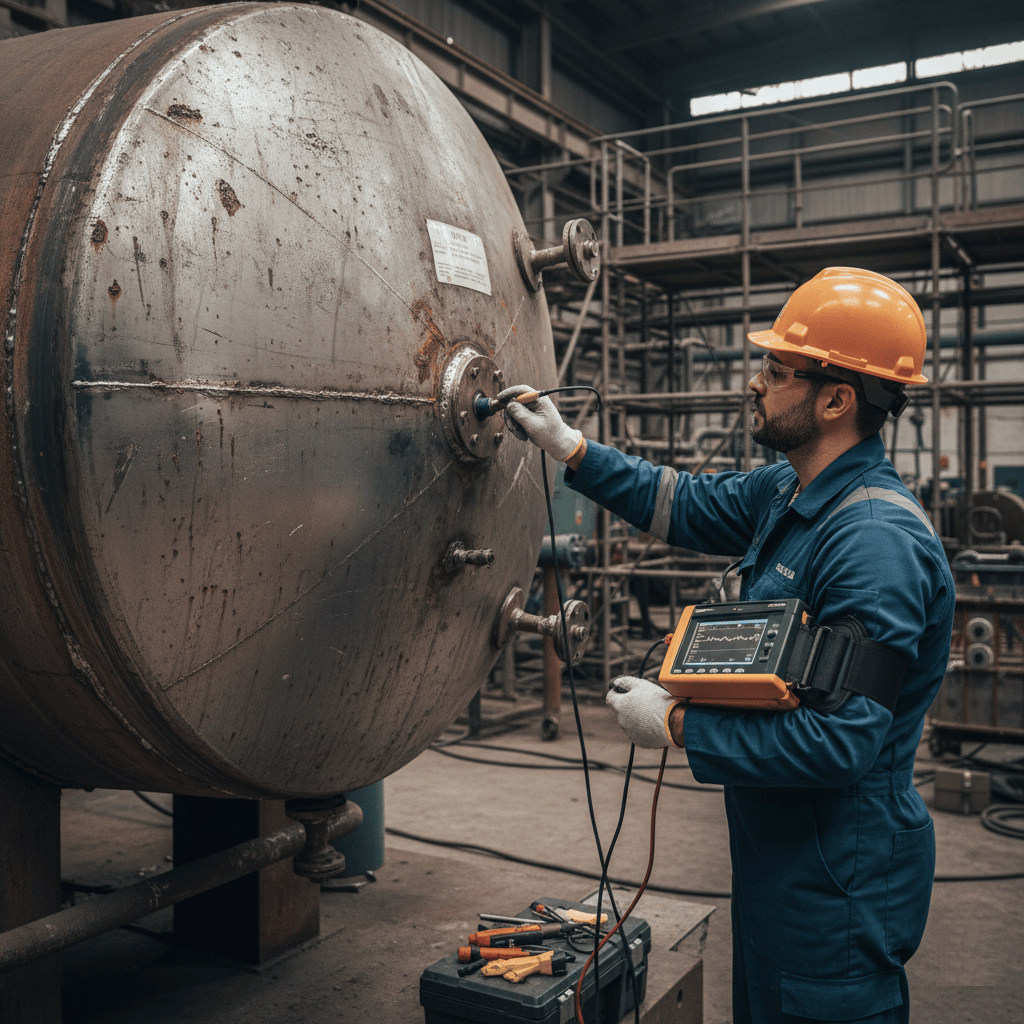
NDT is routinely applied to pressure-retaining equipment across multiple industries, including:
ASME-coded pressure vessels
Boilers and heat exchangers
Process tanks and reactors
Pressure piping connections
Repairs, alterations, and rerates
Inspections focus on weld seams, heat-affected zones, nozzle attachments, shell sections, and other high-stress areas where defects are most likely to develop.
Visual Testing is the first step in pressure vessel inspection and is performed before, during, and after welding. Inspectors evaluate joint preparation, weld profiles, surface condition, and overall workmanship.
VT helps identify visible defects such as cracks, undercut, surface porosity, misalignment, and weld irregularities. It also supports verification of dimensional requirements, weld size, and compliance with fabrication drawings and procedures.
Magnetic Particle Testing is used on ferromagnetic materials to detect surface and slightly subsurface defects. MT is commonly applied to pressure vessel welds, nozzle connections, attachments, and repairs made to carbon steel components.
This method is effective for locating cracks, laps, seams, and stress-related discontinuities that may compromise pressure integrity.
Penetrant Testing is used on both ferrous and non-ferrous materials to reveal surface-breaking defects. PT is especially valuable for stainless steel vessels, alloy components, and areas where cracking or leakage may initiate.
PT identifies fine cracks, porosity, leaks, and fatigue-related damage that may not be visible through visual inspection alone.
Ultrasonic Testing is one of the most critical inspection methods for pressure vessels. UT uses high-frequency sound waves to detect internal defects and evaluate material thickness.
UT is commonly used to:
Examine longitudinal and circumferential weld seams
Detect lack of fusion, inclusions, and internal cracking
Verify wall thickness and identify thinning or corrosion
Evaluate repairs and alterations
UT provides accurate defect sizing and location while keeping the vessel fully intact.
Pressure vessel inspections are performed in accordance with the ASME Boiler and Pressure Vessel Code (BPVC) and applicable project or jurisdictional requirements. NDT supports compliance during:
New vessel fabrication
Repair and alteration work
Rerating or modification projects
In-service inspection programs
Proper inspection documentation is essential for audits, certifications, and regulatory approval.
Prevents leaks, ruptures, and unsafe operating conditions
Ensures compliance with ASME BPVC requirements
Identifies defects before they lead to unplanned downtime
Extends service life of pressure-retaining equipment
Supports safe operation in high-risk environments
Pressure vessel failures are expensive at best and dangerous at worst. NDT helps catch problems early, when they can still be corrected without major disruption.
Pressure vessels demand precise inspection performed by qualified personnel who understand code requirements and real-world operating conditions. Professional NDT provides confidence that welds and materials are fit for service and capable of withstanding operational stress.
Whether supporting fabrication, maintenance, or compliance-driven inspections, pressure vessel NDT is essential for safety, reliability, and long-term performance.
Contact Us to schedule pressure vessel NDT services.
Most critical seams require UT or radiography per ASME code.

