
Maritime NDT services are essential for verifying weld integrity in one of the most demanding service environments in any industry. Constant saltwater exposure, high humidity, cyclic loading, vibration, and corrosion place extreme stress on welded joints and structural components. Nondestructive Testing allows weld quality and material condition to be evaluated without damaging the component or interrupting operations.
Marine NDT supports both new fabrication and in-service inspection across vessels, docks, and offshore structures — helping operators detect defects early, remain code-compliant, and extend the operational life of critical assets.
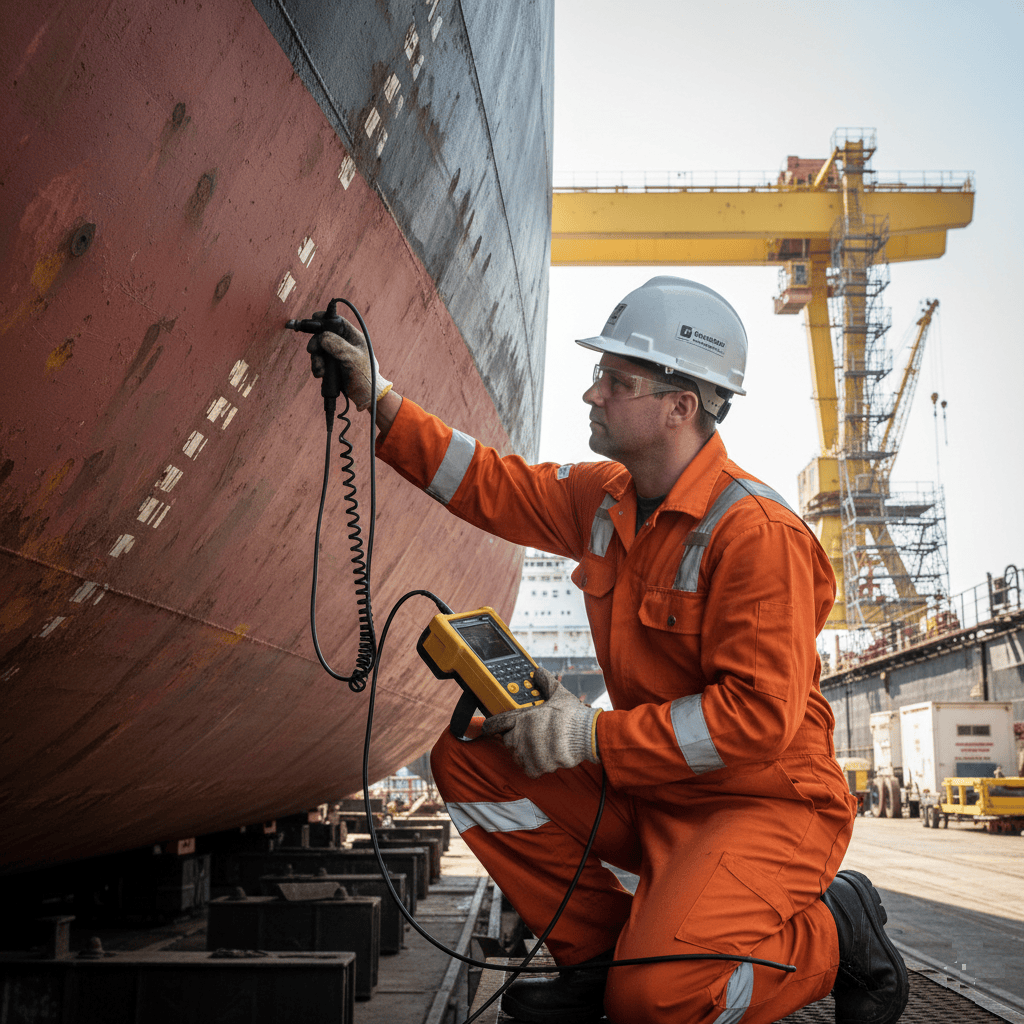
NDT testing services for the maritime industry are routinely applied across a wide range of vessels and waterfront structures:
Each application presents unique inspection challenges related to access, material type, corrosion exposure, and load conditions. Proper NDT method selection ensures defects are identified early — before they compromise safety or lead to costly downtime.
A full suite of NDT methods is available for marine and shipyard environments. Method selection depends on material type, joint geometry, defect type, and access conditions.
The foundation of marine inspection. Evaluates weld profiles, joint fit-up, surface condition, and corrosion damage during fabrication, repair, and final acceptance. Remote VT (RVT) is available for confined spaces and hard-to-access areas on vessels and port facilities.
Widely used for aluminum and stainless steel components. Detects surface-breaking cracks, fatigue damage, porosity, and leaks caused by vibration and corrosion. Commonly applied to aluminum hulls, superstructures, and marine-grade piping.
Used for carbon steel components to identify surface and near-surface cracks, laps, seams, and weld toe defects. Well suited to structural steel, support frames, brackets, and load-bearing marine assemblies. Fast and reliable for both shipyard fabrication and field repair.
Evaluates internal weld quality using high-frequency sound waves. Essential for critical marine welds where internal defects could compromise structural performance or fatigue resistance — including structural frames, heavy-wall connections, and critical repair welds.
Marine and shipyard projects require inspectors who understand both certified marine welding services and the realities of coastal environments. Professional NDT ensures welds meet acceptance criteria and perform reliably under real-world service conditions — saltwater, thermal cycling, dynamic loads, and all.
Whether supporting new vessel construction, dock repairs, or ongoing marine maintenance programs, NWIS provides maritime NDT services with the confidence that welded components are fit for service. All inspections are performed by certified technicians in accordance with applicable codes and client specifications.
Ready to schedule maritime NDT services for your vessel, shipyard, or waterfront project in Florida?
Contact Us to schedule marine and shipyard NDT services.
The four primary methods used in maritime NDT are Visual Testing (VT), Liquid Penetrant Testing (PT), Magnetic Particle Testing (MT), and Ultrasonic Testing (UT). Method selection depends on material type (steel vs. aluminum), joint configuration, and the type of defect being evaluated. Most projects use a combination of methods.
PT (Liquid Penetrant Testing) and VT (Visual Testing) are the primary methods for aluminum hulls and superstructures. MT is not applicable to aluminum because it is non-ferromagnetic. UT can also be used for evaluating weld quality in thicker aluminum sections.
Yes. NWIS provides maritime NDT services throughout Florida for vessels, shipyards, docks, piers, and offshore support structures. Inspections are performed by certified technicians and conducted in accordance with applicable maritime, AWS, and ASME standards.
Marine NDT (Nondestructive Testing) refers to a range of inspection techniques used to evaluate the integrity of welds and structural components on vessels and waterfront structures — without damaging or removing them from service. It matters because marine environments accelerate corrosion, fatigue cracking, and degradation. Identifying defects early prevents failures, reduces repair costs, and keeps vessels compliant with maritime standards.
Shipyard welding inspection typically references AWS D1.1 (Structural Welding Code — Steel), AWS D1.2 (Structural Welding Code — Aluminum), ASME Section IX for pressure-related work, and project- or owner-specific standards. Classification society requirements (ABS, DNV, etc.) may also apply depending on vessel type and flag state.

